


I Picked 300 Dandelions and Made “Honey.” Here’s Why You Should Too.
I spent the better part of a Sunday morning crawling around the garden, picking dandelions. Hundreds of them. One by one, heads off, into the bowl. My partner came out with a cup of coffee for me, looked over at me for a moment, said nothing, smiled, and went back inside.
But what came out of the kitchen two days later was one of the most genuinely surprising things I’ve ever made. Golden, thick, faintly floral, with a warmth from the vanilla that makes it smell like a bakery. People keep asking me what it is. Nobody guesses dandelion.
And that, really, is the whole story of this plant. Everyone overlooks it. Everyone’s been overlooking it for a long time, but humans have been eating and using this wonderful plant as medicine since at least 659 BCE.
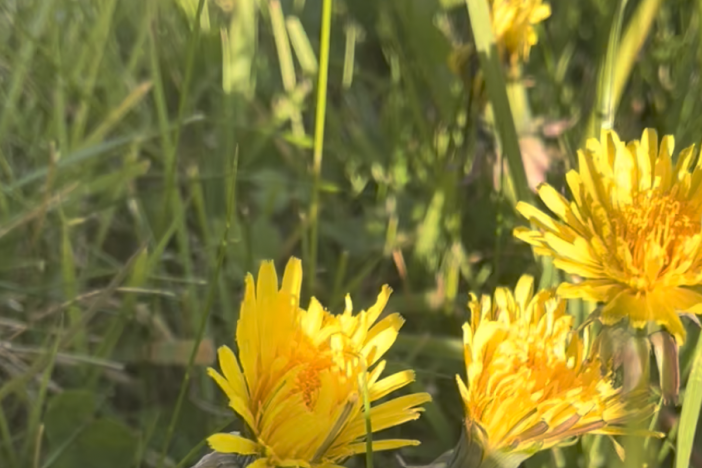
The dandelion is not a weed. It never was.
The word “weed” is a human judgment, not a botanical fact. It just means a plant growing somewhere we’d rather it didn’t. Somewhere along the line, probably when lawn culture took hold in the 20th century, we were told the dandelion was the enemy.
Which is baffling when you look at its history.
The earliest written record of dandelion as a medicinal plant appears in Chinese texts from around 659 BCE, where it was valued specifically for supporting the liver and digestion. By the 10th and 11th centuries, Arab physicians were writing about it under the name *tarakhshaqun* (translating roughly to “bitter herb”), which is almost certainly where the modern Latin *Taraxacum* comes from. From there, it spread across Europe, and by the 13th century, it was appearing in Central European herbal texts alongside 180 other medicinal plants.
Medieval monks grew it in their physic gardens. Ancient Greek and Roman physicians used it. Native Americans integrated it into their diets centuries before Europeans arrived. What’s remarkable is that all these cultures arrived at almost identical conclusions about the plant: that it supports the liver, aids digestion, has diuretic properties, and helps with inflammation, completely independently of each other. No shared texts, no trading of recipes. Just people observing what this plant did and writing it down.
The name itself comes from the French *dent-de-lion*. Lion’s tooth, potentially coming from the serrated leaves.
By the Renaissance, dandelion had made it into official European pharmacopoeias. It was a legitimate medicine, not a kitchen remedy. And then, slowly, we “forgot”.
What dandelions actually do for you
The flower and leaf are packed with vitamins A, C, and several B vitamins, plus potassium, magnesium, iron, and calcium. There are flavonoids in there, and antioxidants that mop up free radicals in the body, the kind of oxidative damage that accumulates over time and contributes to chronic disease. The anti-inflammatory properties are real and measurable, not just herbalist tradition.
The specific compounds responsible for a lot of dandelion’s medicinal action are sesquiterpene lactones, which is what gives the plant its slight bitterness. Bitterness is often a signal of medicinal value. Those bitter compounds stimulate bile production in the gallbladder, which then triggers a cascade of digestive benefits: better fat digestion, more efficient elimination and improved gut motility. For anyone who bloats easily, feels heavy after eating, or has that vague sluggish-liver feeling after a period of not eating brilliantly, dandelion is genuinely worth taking seriously.
Its diuretic effect is also well-documented, supporting the kidneys in flushing excess fluid and toxins. Unlike pharmaceutical diuretics, dandelion replaces the potassium that diuresis removes, because the plant is so high in potassium already, which is an unusual and beautiful combination.
And the specific effect on stomach acidity is one I find particularly interesting: research has found that dandelion can reduce stomach acid by more than 50%. For anyone with acid reflux or gastric discomfort, that’s worth knowing.
None of this means you should replace medication with dandelion honey, obviously. But it does mean this plant is capable of doing a lot more than just annoying you when you look out at your lawn.
Picking them: the bit that’s easy to get wrong
Two things matter when you’re picking dandelions for this recipe.
First: pick them on a dry, sunny day, and pick them when they’re fully open. The flower closes in dull weather and hasn’t fully opened in the bud stage. You want maximum bloom, full petals, that bright yellow. I went out mid-morning when the sun had been up for a few hours, and all the flowers were wide open. Three hundred heads sounds like a lot, but an average-sized garden plus a stretch of unmown verge gets you there faster than you’d think. Take a bowl (or my choice, an empty tea box), go slowly, and enjoy it. Be sure not to pick your dandelions on the grassy verge of a road because, well, you know, car fumes = not so great for your health.
Also, quick note: Please pick your dandelions somewhere you know there haven’t been any chemicals sprayed.
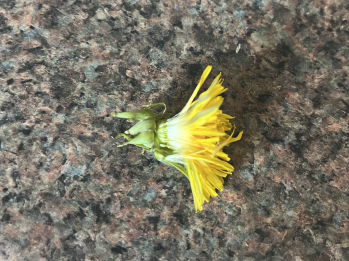
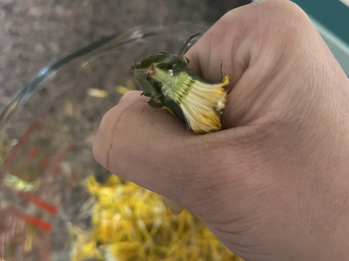
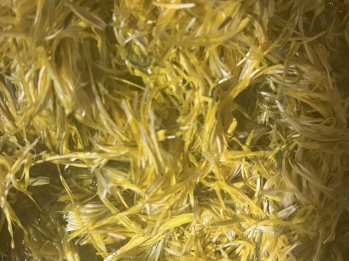
Second, and this step can be a little long, but it’s not worth skipping it: You need to separate the yellow petals from the green calyx at the base. The green part is bitter in a way that doesn’t cook out or mellow. It’s sharp and unpleasant, and it could ruin your honey like syrup. You’re not looking for bitterness; you want the clean, sweet floral quality of the petals only.
I stood at the kitchen bench with my headphones in and worked through all 300 heads (my partner helped out a little but quickly became much more interested in literally anything else). You pinch the yellow and pull upward, and the petals come free in a little bunch. Some of them can be a little stubborn. I found the easiest way with these was to grab the petals with one hand and the base with the other and twist in opposite directions.
The calyx goes in the compost. The whole process took about 45 minutes to an hour. Some people find this meditative. I found it mildly annoying for the first ten minutes and then quite peaceful once I settled into it.
Once you’ve got your petals separated, hurray! Well done. Now, rinse them well. Even from a clean patch with no spray, there’ll be small insects and general garden dust in there.
Making it: the actual process
I used a slow cooker for the infusion stage. The petals went in with enough cold water to cover them generously, about 1.5 litres for the quantity I had, and a whole lemon, sliced into rounds. The lemon matters more than many recipes let on. The acidity extends shelf life, it lifts the flavour and stops the whole thing tasting flat, and it helps the finished syrup stay clear and golden rather than going murky. Slow cooker on its lowest setting for three or four hours, until the water has taken on a deep golden colour and the kitchen smells extraordinary.
Then I turned it off and left it overnight. This is important. The long steep after the heat is turned off extracts the last of the colour and flavour from the petals in a gentler way than continued heat would. Think of how much better a tea tastes if you leave the bag in for five minutes rather than thirty seconds. Same principle, longer timescale.
The next day, I strained everything through a sieve lined with a piece of muslin, pressing the spent petals gently to get every last drop. The liquid at this point is amber and gorgeous — it almost looks like it’s already honey.
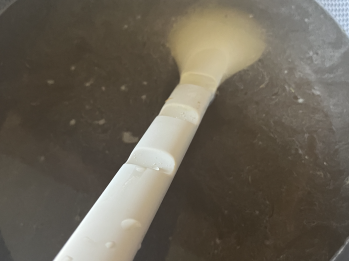
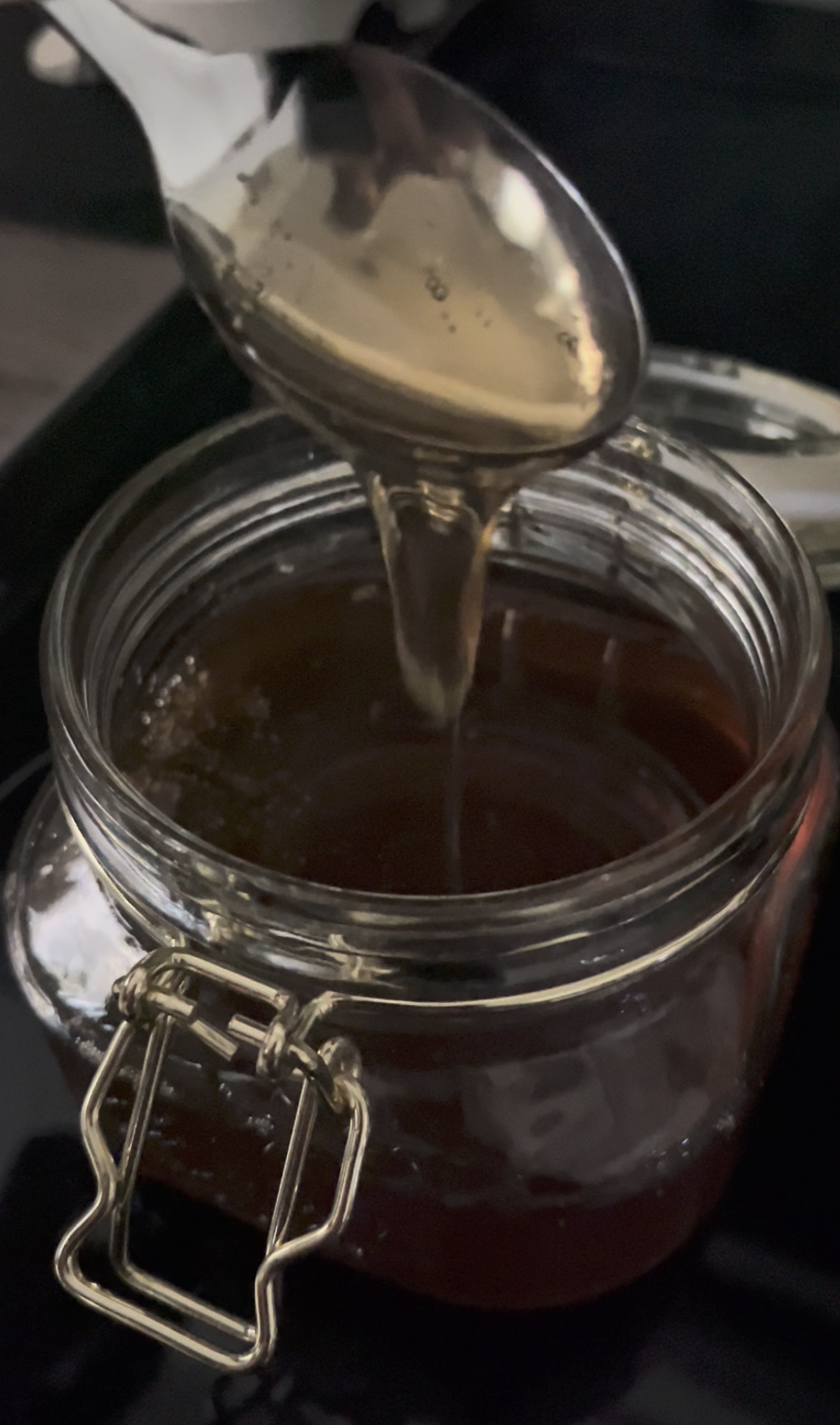
Then, the reduction: Where I transferred the liquid to a pan (not coated in non-stick if you can avoid it – another post covering this soon), added the sugar (more on which sugar in a moment), and a small splash of good vanilla extract. Medium heat, stirring regularly, for somewhere between 20 and 40 minutes, until it starts to thicken. The test is whether it coats the back of a spoon; it should be slightly runnier than you think you want, because it thickens as it cools.
Pour into sterilised jars, and this is something many recipes don’t mention: Leave them to cool completely at room temperature before you put them in the fridge. Going from very hot directly into a cold fridge causes condensation to form on the inside of the lid, which leads to a white crystalline residue forming on the surface of the honey. It’s harmless, but it doesn’t look great. Cool first. Then the fridge. Keeps for several weeks.
Why coconut sugar is worth the extra pennies
Most recipes call for white caster sugar. In all recipes, where possible, I like to use coconut sugar; it’s one of those small decisions that turns out to make a difference both in flavour and in what the finished product does to your body.
Coconut sugar is made from the sap of coconut palm flower buds, it’s nothing to do with the coconut itself, despite what the name implies. The sap is tapped and then reduced over heat until the water evaporates, leaving behind a granulated sugar with a natural caramel colour and a slight molasses depth to it. It undergoes minimal processing compared to refined white sugar, and it retains trace minerals, potassium, iron, and zinc that the refining process strips out of cane sugar entirely.
The thing that matters most, though, is the glycaemic index. White sugar sits at around 60 to 65 on the GI scale. Coconut sugar comes in at around 35. Anything under 55 is considered low, so white sugar is getting uncomfortably close to the high end while coconut sugar isn’t even in the conversation.
Why does that matter in a honey recipe? Because a lower GI means a slower release of glucose into the bloodstream, which means less of a spike and less of a subsequent crash. That’s especially relevant when you’re making something sweet specifically because of its health associations. You’re already going to the trouble of making a plant-based honey with genuine medicinal properties. Using a sugar that doesn’t spike your blood glucose the moment you eat it is just the logical extension of that thinking.
Coconut sugar also contains small amounts of inulin, a prebiotic fibre that slows glucose absorption further and feeds beneficial gut bacteria. And the flavour? Honestly, this might be the best argument of all. The flavour is genuinely lovely in this recipe. That slight caramel note with the vanilla and the floral sweetness of the dandelions is a combination that white sugar could never produce.
- Worth being honest about the limits, too: this is still sugar. If you’re diabetic or watching blood glucose carefully, coconut sugar is not a free pass. But as a swap for white sugar in a recipe like this, it is a better choice.
What you actually end up with
A deep amber syrup that sits between runny honey and golden syrup in consistency. Warm, floral, faintly earthy. The vanilla gives it a roundness that makes it smell like something you’d find in a good bakery. My partner, who said nothing when I was in the garden and nothing when I was straining the muslin at 6 am, tried a spoonful off the back of a teaspoon, paused, and said: “Oh, that’s actually really good.”
That felt like enough.
I’ve been stirring it into hot water with lemon as a morning drink, using it in porridge, and drizzling it over yoghurt with walnuts. It also works as a glaze for roasted root vegetables in a way that’s actually quite surprising. The floral note against something savoury and caramelised is excellent. It’s the kind of thing that makes you feel slightly smug when you serve it to someone and explain where it came from.
People have been eating this plant and using it as medicine for thousands of years. Science catches up more every decade that goes by. And it’s growing for free in your garden right now, waiting.
You might as well use it! Have fun and let me know how you get on 🙂
Love,
nousana.
Important note: Dandelion honey is vegan and plant-based. Not suitable as a replacement for medical treatment. If you have an allergy to plants in the Asteraceae family (ragweed, chrysanthemums, chamomile), consult a doctor before consuming dandelion products regularly. Keep away from children under 12 months, as with all honey-style preserves.
Join the movement
Quick link to our recent most favourite products
Lions Mane
Ashwagandha
Marine Collagen
Rosewater
Coconut Oil
Happy Healthy and Wealthy is your place to discover your happiest, healthiest and wealthiest self. You’re already amazing, just as you are so let’s grow together and become truly incredible.
Everyone’s invited!
Join the monthly Happy Healthy and Wealthy newsletter now and never miss a beat! We want you and your incredible self to join the movement where you’ll enjoy becoming part of our valued community. It’s a place to share insights, thought provoking questions and journey towards being your best self. We promise to never spam you and we will never share your data. You can unsubscribe at any time – although we doubt you’ll want to!
If you’re interested in collaboration, please contact us through the link, we’d love to hear from you.